

Orchestra
AI workflow orchestration for complex operations.
Role
Product designer lead
Scope
0 → 1 Product
Focus
AI & Automationֿ
Year
2026
This product is still in stealth. Names, selected data, and some visual details have been adapted to protect the product, while the underlying challenges, process, and design decisions remain true to the original work.
Detailed
TL;DR


Company & product context
Turn complex
processes into real progress.
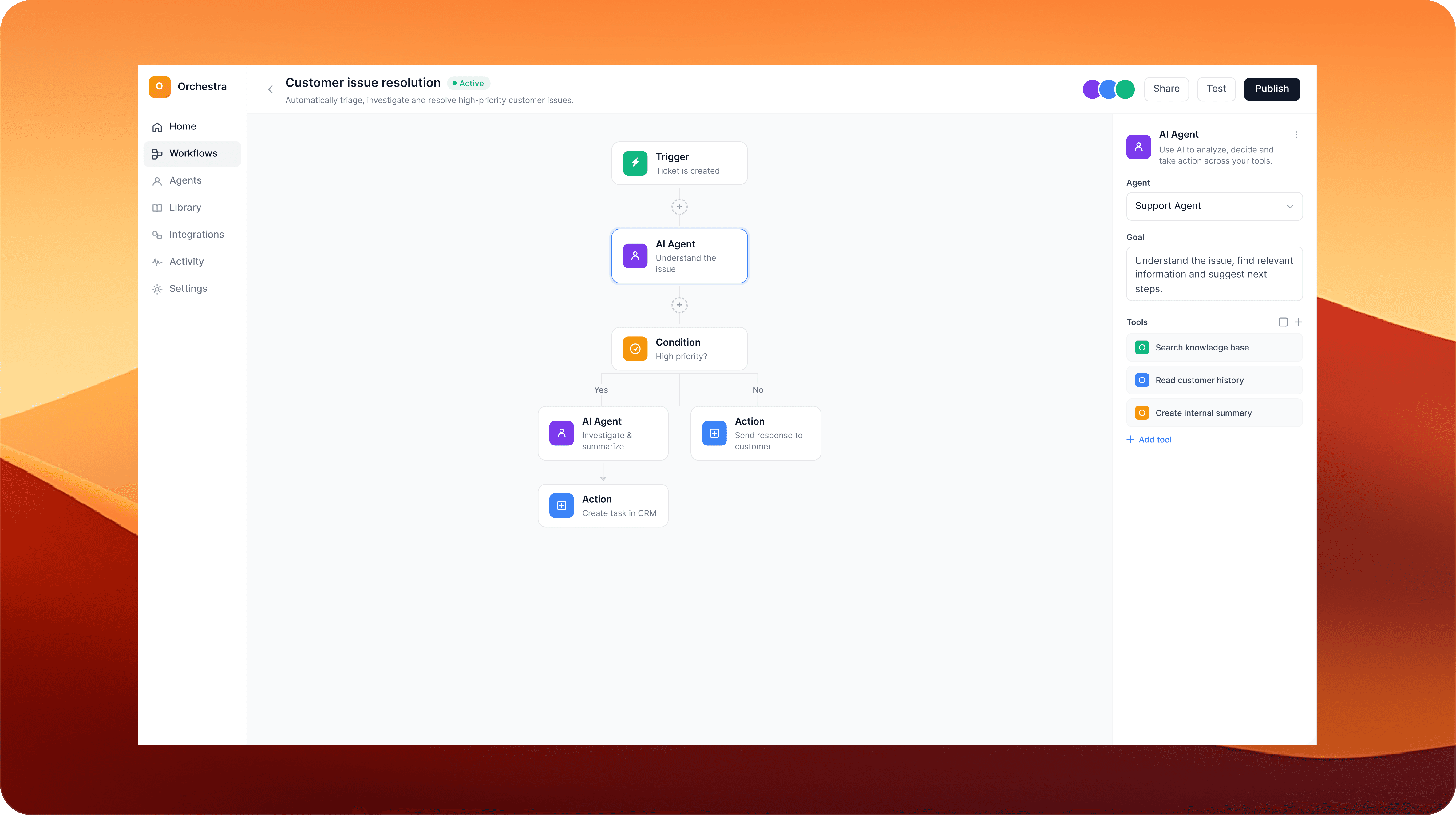
Orchestra gives teams the power to design, automate and manage end-to-end workflows where people, systems and AI agents work together.
It helps organizations move faster, reduce manual work and deliver better outcomes without relying on engineering resources.
Design with AI
Describe what you need. Get a working flow.
Connect anything
Integrate with your existing tools and data.
Operate at scale
Improve workflows across the organization.
02
My role
Product design from early definition to the AI interaction model.
My scope covered the workflow architecture, conversational entry points, agent configuration, trust patterns and the final interaction model, turning an ambiguous AI capability into a system teams could understand and control.
Product definition
Turning the problem space into a clear product model.what you need. Get a working flow.
Workflow architecture
Defining how triggers, logic, agents and actions work together.
AI interaction patterns
Designing how users instruct, review and control agent behavior.
03
The product
problem
Powerful automation existed,
but it was too complex to build.
Teams were relying on manual processes, custom development or multiple disconnected tools to automate their work. This created friction, slowed down operations and made it difficult to scale automation
across the organization.

04
Research beyond
direct competitors
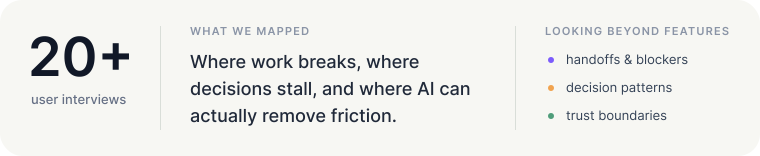
We studied how teams work, make decisions and adopt AI in real workflows.
To understand the opportunity, we analyzed workflow platforms, AI tools and adjacent products, and conducted interviews with admins, operators and business teams across different industries.
05
Key product decisions
Three decisions shaped how the product handles complexity.
Each one came from a trade-off: speed vs. control, guidance vs. flexibility, and AI autonomy vs. human oversight.
01
Prompt first
Lower the barrier to starting
02
Progressive
complexity
Keep simple flows simple
03
Visible control
Access schedules, resources, and what's happening now.
06
From idea to flow
Two entry points,
one mental model.
Start with AI or begin from a proven template, both paths lead into the same editable workflow.

07
Trust & control
AI autonomy only works when the system stays inspectable.
I treated trust as part of the workflow itself: teams can see what an agent did, understand the reason for a decision at a useful level, and require human approval before sensitive actions continue.


08
The final
experience
AI is a participant in the workflow, not a layer on top.
The final model brings triggers, deterministic logic, AI agents, human approvals and actions into one visual workspace, so teams can automate complex work without losing visibility or control.

09
Current state
The product is still in stealth, so the case focuses on the decisions behind it.
This phase established the workflow model, AI interaction patterns and trust controls needed to keep developing the product, while confidential launch data remains intentionally undisclosed.

Orchestra
AI workflow orchestration for complex operations.
Role
Product designer lead
Scope
0 → 1 Product
Focus
AI & Automationֿ
Year
2026
This product is still in stealth. Names, selected data, and some visual details have been adapted to protect the product, while the underlying challenges, process, and design decisions remain true to the original work.
Detailed
TL;DR
Company & product context
Engineering intelligence for the AI era.
Orchestra gives teams the power to design, automate and manage end-to-end workflows where people, systems and AI agents work together.
It helps organizations move faster, reduce manual work and deliver better outcomes without relying on engineering resources.
Design with AI
Describe what you need. Get a working flow.
Connect anything
Integrate with your existing tools and data.
Operate at scale
Improve workflows across the organization.
02
My role
Product design from early definition to the AI interaction model.
My scope covered the workflow architecture, conversational entry points, agent configuration, trust patterns and the final interaction model, turning an ambiguous AI capability into a system teams could understand and control.
Product definition
Turning the problem space into a clear product model.what you need. Get a working flow.
Workflow architecture
Defining how triggers, logic, agents and actions work together.
AI interaction patterns
Designing how users instruct, review and control agent behavior.
03
The product
problem
Powerful automation existed,
but it was too complex to build.
Teams were relying on manual processes, custom development or multiple disconnected tools to automate their work. This created friction, slowed down operations and made it difficult to scale automation
across the organization.
04
Research beyond
direct competitors
We studied how teams work, make decisions and adopt AI in real workflows.
To understand the opportunity, we analyzed workflow platforms, AI tools and adjacent products, and conducted interviews with admins, operators and business teams across different industries.
05
Key product decisions
Three decisions shaped how the product handles complexity.
Each one came from a trade-off: speed vs. control, guidance vs. flexibility, and AI autonomy vs. human oversight.
01
Prompt first
Lower the barrier to starting
02
Progressive
complexity
Keep simple flows simple
03
Visible control
Access schedules, resources, and what's happening now.
06
From idea to flow
Two entry points,
one mental model.
Start with AI or begin from a proven template, both paths lead into the same editable workflow.
07
Trust & control
AI autonomy only works when the system stays inspectable.
I treated trust as part of the workflow itself: teams can see what an agent did, understand the reason for a decision at a useful level, and require human approval before sensitive actions continue.
08
The final
experience
AI is a participant in the workflow, not a layer on top.
The final model brings triggers, deterministic logic, AI agents, human approvals and actions into one visual workspace, so teams can automate complex work without losing visibility or control.
09
Current state
The product is still in stealth, so the case focuses on the decisions behind it.
This phase established the workflow model, AI interaction patterns and trust controls needed to keep developing the product, while confidential launch data remains intentionally undisclosed.
Orchestra
AI workflow orchestration for complex operations.
Role
Product designer lead
Scope
0 → 1 Product
Focus
AI & Automationֿ
Year
2026
This product is still in stealth. Names, selected data, and some visual details have been adapted to protect the product, while the underlying challenges, process, and design decisions remain true to the original work.
Detailed
TL;DR

Company & product context
Turn complex
processes into real progress.
Orchestra gives teams the power to design, automate and manage end-to-end workflows where people, systems and AI agents work together.
It helps organizations move faster, reduce manual work and deliver better outcomes without relying on engineering resources.
Design with AI
Describe what you need. Get a working flow.
Connect anything
Integrate with your existing tools and data.
Operate at scale
Improve workflows across the organization.
02
My role
Product design from early definition to the AI interaction model.
My scope covered the workflow architecture, conversational entry points, agent configuration, trust patterns and the final interaction model, turning an ambiguous AI capability into a system teams could understand and control.
Product definition
Turning the problem space into a clear product model.what you need. Get a working flow.
Workflow architecture
Defining how triggers, logic, agents and actions work together.
AI interaction patterns
Designing how users instruct, review and control agent behavior.
03
The product
problem
Powerful automation existed,
but it was too complex to build.
Teams were relying on manual processes, custom development or multiple disconnected tools to automate their work. This created friction, slowed down operations and made it difficult to scale automation
across the organization.
04
Research beyond
direct competitors
We studied how teams work, make decisions and adopt AI in real workflows.
To understand the opportunity, we analyzed workflow platforms, AI tools and adjacent products, and conducted interviews with admins, operators and business teams across different industries.
05
Key product decisions
Three decisions shaped how the product handles complexity.
Each one came from a trade-off: speed vs. control, guidance vs. flexibility, and AI autonomy vs. human oversight.
01
Prompt first
Lower the barrier to starting
02
Progressive
complexity
Keep simple flows simple
03
Visible control
Access schedules, resources, and what's happening now.
06
From idea to flow
Two entry points,
one mental model.
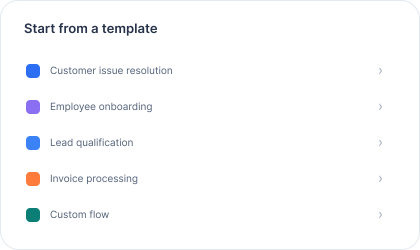
Start with AI or begin from a proven template, both paths lead into the same editable workflow.

07
Trust & control
AI autonomy only works when the system stays inspectable.
I treated trust as part of the workflow itself: teams can see what an agent did, understand the reason for a decision at a useful level, and require human approval before sensitive actions continue.
08
The final
experience
AI is a participant in the workflow, not a layer on top.
The final model brings triggers, deterministic logic, AI agents, human approvals and actions into one visual workspace, so teams can automate complex work without losing visibility or control.
09
Current state
The product is still in stealth, so the case focuses on the decisions behind it.
This phase established the workflow model, AI interaction patterns and trust controls needed to keep developing the product, while confidential launch data remains intentionally undisclosed.